Love & Connection: Emotional Resilience in Foster Care
Love and connection support emotional resilience in foster care by providing children with safety (both actual and perceived), consistency, and stable relationships. Trauma-informed caregiving helps children regulate emotions, build trust, and heal over time. Even temporary, nurturing connections can positively influence a child’s long-term emotional health and attachment outcomes.
Children who have experienced trauma often approach relationships cautiously. Healing does not begin with affection or compliance; it begins with safety, predictability, and presence. Foster children heal when caregivers remain calm, predictable, and responsive, especially during transitions and setbacks. Foster parents also need support to stay emotionally steady, because caregiver regulation plays a key role in a child’s ability to recover from trauma.
Adriel supports families through foster parent training, spiritual support structures, and advocacy that centers the well-being of both child and caregiver, not reactive behavior management.
How Love Supports Healing While Trust is Still Building
Children impacted by trauma do not automatically connect. They need environments where attachment feels safe. According to the Centers for Disease Control and Prevention (CDC), stable, nurturing relationships are among the strongest protective factors for long-term mental and emotional health.
Love supports healing when it looks like:
-
Safety—and feeling safe—before compliance
-
Predictability and follow-through
-
Curiosity about behavior instead of control
-
Repair after rupture and reconnection
These principles are reinforced through Adriel’s training and trauma-informed care resources.
What Helps Foster Parents Remain Emotionally Steady?
Emotional resilience is not about avoiding feelings; it’s about staying grounded through them. Helpful strategies include:
-
Separating the child’s behavior from your worth
-
Lowering expectations during transition points
-
Naming grief openly and honestly
-
Practicing radical self-compassion
The American Academy of Pediatrics (AAP) notes that caregiver regulation directly supports a child’s emotional regulation. Seeking peer support, counseling, and spiritual encouragement is part of sustained resilience.
Adriel’s spiritual care offerings support caregiver regulation by helping foster parents process grief, uncertainty, and emotional fatigue, so they can remain calm, present, and responsive when children need stability most.
How Do Strong Bonds Form Without Rushing Attachment?
Attachment must be earned at the pace of the child, not the timeline of the adult. Connection deepens through:
-
Preparation for transitions
-
Warm, firm boundaries
-
Offering choice and autonomy
-
Connecting before correcting
-
Respecting a child’s past story
As one Adriel foster family shared:
“Foster parenting has shown our family what it looks like to love like Jesus… knowing that no matter how long they are in our home, we’ve planted a seed and been the loving and safe place the child needed.”
— The Sell Family
This echoes a foundational tenet of Adriel’s approach: presence matters, even when permanence is uncertain.
What Does Real Progress Look Like in Foster Care?
Progress is quiet, incremental, and often non-linear. It might show up as:
-
Shorter emotional outbursts
-
Asking for help
-
Increased engagement
-
Willingness to try again
Expect setbacks—especially around visits, holidays, or court involvement—they do not erase growth.
As another foster family shared:
“Fostering is giving a child a safe place to land and showing them, they matter…the joy comes from the little moments that mean everything.”
— The Savenok Family
These everyday experiences lay the foundation for emotional resilience.
Why Does Love Matter Even When Outcomes Are Uncertain?
Foster care inherently involves uncertainty: children may reunify, placements may change, and goodbyes may come even when bonds are strong. Love matters all the more. Even temporary safe connections help reshape how a child understands trust, safety, and self-worth, and your faith can mean the world to them in those moments.
This understanding aligns with Adriel’s core mission: providing quality care for children, young adults, and families in the spirit of Christian love.
What You Need to Know About Love and Emotional Resilience in Foster Care
Love and connection are not about perfection. They are about consistency, curiosity, compassion, and presence. Emotional resilience grows through reinforcing calm care. Every safe moment matters. Every relationship leaves a mark. Best practices for foster parents:
-
Understand how love supports healing even while trust is still in the building stage
-
Gain and maintain emotional steadiness
-
Remain patient while allowing strong bonds to form
-
Know what real progress looks like
-
Keep the faith that love matters even when outcomes are uncertain
Helpful Resources for Foster Parents
We welcome you to view these two helpful resources from our therapists:
-
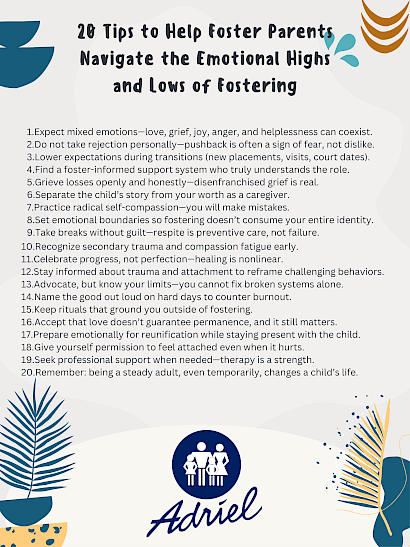
20 Tips to Help Foster Parents Navigate the Emotional Highs and Lows of Fostering
-
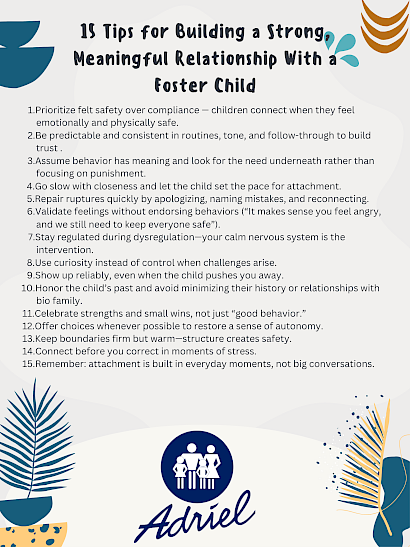
15 Tips for Building a Strong, Meaningful Relationship with a Foster Child
FAQs: Love, Connection, and Emotional Resilience in Foster Care
How do love and connection build resilience in foster care?
Love and connection build emotional resilience in foster care when children experience palpable safety, consistent presence, and compassionate responses to behavior. Stable, nurturing relationships help children regulate emotions and rebuild trust after trauma. Even when placements are temporary, caregiver steadiness can positively influence a child’s long-term emotional health and attachment.
How does trauma affect a child’s ability to connect?
Trauma can disrupt attachment and emotional regulation, causing children to resist closeness even when they want it. Because their early experiences taught them that relationships aren’t safe or reliable, trauma can also make it hard for foster children to connect. They may struggle with trust, push caregivers away, or react strongly to small stressors because their nervous system is stuck in survival mode. Emotional expression and attachment can look confusing or inconsistent, not from defiance, but from self-protection. With consistent, patient, trauma-informed care, many children can still build secure connections over time.
Is it healthy to feel attached if reunification is the goal?
Yes. Attachment supports healing; loving a child fully, even temporarily, supports long-term emotional resilience.
What is co-regulation?
Co-regulation is when a calm adult helps a child regulate emotions through presence, tone, and predictability.
How can foster parents protect their own emotional health?
Respite, peer support, counseling, spiritual care, and maintaining identity outside of fostering are essential.
Do small moments really matter?
Yes. Research from the CDC and AAP shows consistent everyday interactions are the strongest drivers of healing and attachment.
Explore foster parenting or contact us for more information.